
Deel Review 2026: An Honest Look After Using It for Global Hiring
If you've ever tried to hire someone in another country, you already know the drill: a labyrinth of local labor laws, tax registrations, benefits requirements, and entity setup costs that can take months and tens of thousands of dollars before your new hire even starts. Deel promises to make all of that disappear. After spending significant time navigating the platform — across Employer of Record (EOR), Global Payroll, and Contractor Management — I'm ready to give you the honest breakdown.
5/21/20267 min read
What Is Deel, Actually?
Deel launched in 2019 out of Y Combinator and has since grown into one of the largest global HR platforms on the market, now valued at $17 billion. At its core, it's a platform designed to help companies hire, pay, and manage talent in 150+ countries — without needing to set up a legal entity in every market they operate in.
The platform has expanded considerably since its early contractor-focused days. Today it covers:
Employer of Record (EOR) — Deel becomes the legal employer in countries where you don't have an entity
Global Payroll — Run payroll across your own existing entities worldwide
Contractor Management — Onboard, pay, and manage international freelancers and contractors
Deel HR — A full-stack HRIS added in 2026 that unifies all worker types in one interface
Immigration, Equity, Device Management, and more — A growing suite of add-ons
The ambition is clear: be the single system for your entire global workforce. Whether that ambition translates into a good experience depends heavily on which products you're using and how complex your needs are. Let me walk through the three core areas I've spent the most time in.
Employer of Record (EOR): The Flagship, and for Good Reason
Deel's EOR product is the one that put them on the map, and it remains their strongest offering.
The core promise: you can hire a full-time employee in a country where you have zero legal presence, and Deel handles everything — employment contracts adapted to local law, payroll taxes, statutory benefits, terminations, and compliance. Deel becomes the legal employer on paper; the employee works for you day-to-day.
What Works Well
Speed of onboarding. In markets where Deel operates through its own owned entities (which includes the US, UK, Germany, Netherlands, Singapore, Australia, and most of Western Europe), the experience is fast. You can realistically go from "we want to hire someone in Germany" to "that person has a compliant contract and is onboarded" in days rather than weeks or months.
Compliance confidence. This is the part that's genuinely hard to replicate without Deel. Employment law varies enormously by country — notice periods, severance rules, mandatory benefits, local tax withholding — and getting any of it wrong creates real legal and financial exposure. Deel's compliance engine handles all of it automatically, and for companies that have been managing this across spreadsheets or ad hoc local lawyers, the relief is immediate.
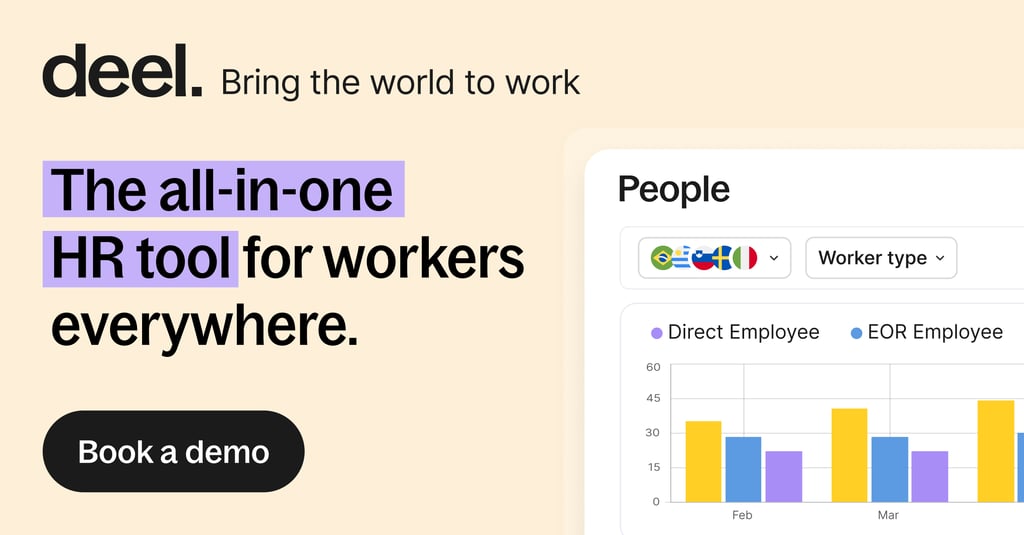
The 2026 unified platform. Deel rolled out a full-stack HR interface in 2026 that lets you manage direct employees, EOR employees, and contractors all in a single dashboard. This is genuinely useful if your workforce is a mix of all three, which is increasingly the norm.
The Honest Caveats
Owned-entity vs. partner-market experience is not equal. Deel covers 150+ countries for EOR, but it operates through a hybrid model: roughly 250 owned entities in high-volume markets, and vetted local partners elsewhere. In owned-entity markets, the experience is tight — faster onboarding, cleaner compliance handoffs, and direct accountability. In partner markets, quality can vary. Support responsiveness, termination timelines, and local law nuance are all less predictable. If you're hiring in a Tier 1 market, this isn't a concern. If you're hiring in a less-common jurisdiction, ask specifically which model applies.
Pricing is real, but the total cost is higher than the sticker. EOR is listed from $599/employee/month. That's the honest base rate. What's less prominently disclosed: currency conversion fees (stated at 0.6–2% above mid-market rates, though user reports suggest actual spreads running 2–5.5%), payment processing charges, and in some cases expedited onboarding fees. For a single EOR hire, this may not materially change your calculus. For a larger team, it's worth stress-testing the numbers before you commit.
Invoice timing. Multiple users flag this: Deel invoices early (sometimes mid-month for the following month's payroll) with short payment windows. If you're managing tight cash flow, this can create friction.
Contractor Management: The Entry Point That Still Earns Its Keep
For most companies, Contractor Management is where they start with Deel — and it's easy to see why. At $49/contractor/month, it's the most accessible price point, and it solves a genuinely messy problem.
What Deel Gets Right Here
Localized contracts, automatically. Deel generates locally compliant contracts for each contractor based on their country. This matters more than it might seem. A generic "independent contractor agreement" that works fine in the US may be legally meaningless — or actively dangerous — in Brazil, France, or South Africa. Deel's contract templates are adapted to local requirements, and they're updated as laws change.
Misclassification protection. This is increasingly important. Misclassifying an employee as a contractor is a compliance risk that can result in back taxes, penalties, and forced reclassification — sometimes retroactively. Deel's platform applies automatic classification checks and flags situations where a contractor relationship might not hold up under local scrutiny. It doesn't replace legal advice, but it's a meaningful safeguard for companies that don't have in-house employment lawyers reviewing every contractor engagement.
Multi-currency payments. Contractors can receive payments in 120+ currencies, via local bank transfers, SWIFT, or the Deel card. This is operationally smooth compared to the alternative of manually wiring payments to a dozen contractors in different countries every month.
Invoice management. Contractors submit invoices through the platform, and approvals, revisions, and payment confirmations all happen in one place. For teams managing 10+ contractors across multiple countries, the time savings are real.
What to Watch Out For
Withdrawal fees add up. Local bank transfers are free, but cross-border transfers run $5, SWIFT withdrawals $10, and the Deel Instant Card can run 0.75–2% depending on region. Contractors who are paid frequently and withdraw in smaller amounts will feel this more than others.
The platform has a lot of surface area. Deel has added many product lines over the past two years. For a contractor manager focused only on the contractor module, the interface can feel more complex than the task requires. Navigation has improved, but new users without a dedicated customer success manager may spend time orienting themselves.
Global Payroll: For Companies That Have Entities and Want to Consolidate
Global Payroll is Deel's offering for companies that already have their own legal entities in multiple countries and want to run payroll for those employees through a single platform. This is a different use case from EOR — here, you remain the legal employer; Deel is providing the payroll execution infrastructure.
What Works
Consolidation. If you're currently running payroll through a patchwork of local providers — one for the UK, one for Germany, one for Canada — the appeal of consolidating into a single platform is obvious. Unified reporting, consistent workflows, and a single point of contact for payroll questions is genuinely valuable at scale.
Automated salary calculations and compliance. Deel handles salary calculations, deductions, and tax withholdings in each country, accounting for local requirements. Payroll runs through local rails where possible, which reduces delays and FX conversion losses compared to routing everything through a single currency and converting at the other end.
Integration ecosystem. Global Payroll connects to major HRIS and accounting tools, so data doesn't have to flow manually between systems. This matters for finance and HR teams who are already running other software.
The Real Consideration
Pricing and setup costs. Global Payroll starts at $29/employee/month — reasonable at scale — but comes with a $1,000 one-time implementation fee per legal entity. For a company with entities in five countries, that's $5,000 upfront before you've processed a single payroll run. Budget accordingly.
It's better in well-supported markets. Similar to EOR, the Global Payroll experience is strongest in countries with deep Deel support infrastructure. If your entities are in high-volume markets, this is a non-issue. Emerging markets may require more manual oversight.
Pricing: The Full Picture
Here's an honest summary of Deel's pricing as of 2026:
ProductStarting PriceContractor Management$49/contractor/monthGlobal Payroll$29/employee/month + $1,000/entity setupEmployer of Record$599/employee/month
These are the list prices. The effective cost is higher when you factor in:
Currency conversion fees (2–5.5% in practice, per user reports)
Payment processing (2.9% + $0.30 for credit cards; $5 for ACH)
Withdrawal fees for contractors
Add-on services (immigration, equity, device management)
Customer reviews consistently report actual costs running 26–46% higher than list prices once all variable charges are accounted for. This doesn't make Deel a bad deal — the alternative (local entities, local lawyers, local payroll providers in every country) is almost always more expensive and more operationally complex. But it does mean you should build a realistic total cost of ownership model before committing.
Who Is Deel Actually Best For?
After spending real time with the platform, here's my honest take on fit:
Deel is a strong fit if:
You're hiring internationally in multiple countries and don't want to set up local entities
You have a mixed workforce — some full-time employees, some contractors — and want to manage them in one place
You're operating in Tier 1 markets (US, EU, UK, Australia, Singapore) where Deel's owned-entity infrastructure is strongest
Compliance is a genuine concern for you, not an afterthought
Deel may not be the right fit if:
Your hiring is purely domestic and simple — US-only payroll tools are often cheaper and easier for straightforward cases
Your budget is extremely tight and you're only managing a handful of contractors (the cost-benefit math changes at small scale)
You need deep support in emerging or unusual markets, where the partner-entity experience is less predictable
The Bottom Line
Deel has earned its position as one of the most recognized platforms in global HR. The core products — EOR, Contractor Management, and Global Payroll — genuinely solve hard problems that previously required expensive and time-consuming workarounds. The 2026 platform unification is a meaningful improvement for companies managing a mix of worker types.
The main things to go in with eyes open about: the effective total cost is higher than the headline prices suggest, the experience varies between owned-entity and partner markets, and the platform's breadth can feel like a lot to navigate if you're only using one module.
But for companies that are serious about global hiring and want a platform that handles compliance, payroll, and contractor management without requiring a team of local lawyers in every market — Deel is one of the best options available, and it's gotten meaningfully better in 2026.
Ready to try it? Start with Deel here →
Disclosure: This post contains affiliate links. If you sign up for Deel through my link, I may earn a commission at no extra cost to you. All opinions are my own and based on genuine use of the platform.

